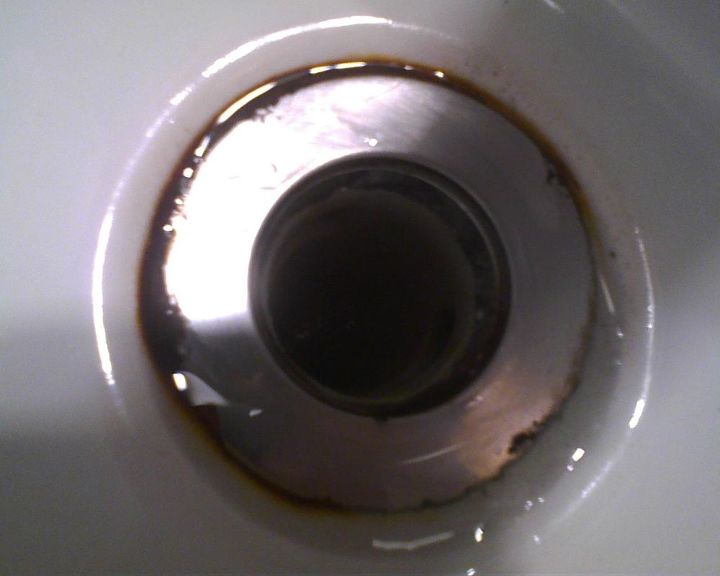


I am not an expert in corrosion, but I'll throw my two cents in anyway. I am assuming that is "rust" you see around the drain.
All metals are in a constant state of trying to return to their natural state as they were in the ground. Corrosion byproducts/rust is the most common visual evidence of that process. Some elements/materials tend to accelerate the process while others tend to slow it down.
...»
The material found in some tap water can tend to accelerate the process.
Drain fixtures come in a wide range of quality. The less expensive ones are made of a cheaper material and more likely to corrode faster. Chrome drains, for example, are "dipped" in chrome which creates a barrier between the metal and the materials (i.e.: water, oxygen, etc...) that cause corrosion. If that layer of chrome gets chipped or worn off, corrosion will start almost immediately.
I suspect replacing the drain unit with a better quality one (i.e.: stainless) will greatly reduce this problem if not eliminate it altogether.
@Hewitt...That's really good to know! I had no idea they had different "quality" of these except that my OLD sink had no problem and my NEW sink, (which came with that piece attached) does....but not to that extent...Appreciate knowing it can in fact be replaced...
@Donna, have you been using drain cleaners or Bleach in the sink regularly? Cause either one of those has such a high impact on metals...
Certain cleaners can speed up the erosion process, like Sharron mentioned. Even "natural" cleaners! Watch out for anything with especially acidic or basic ingredients.
I got that one time because I left the lime away on the metal too long. I didn't realize it was phosphoric acid until it was too late. Probably something like that caused this degradation of the metal.
I would check with a local plumbing supplier, not a big box store, for a stainless steel version....not a chrome plated base metal version.....or a brass version that has been chrome plated.
I have found that certain cleaners cause the metal to discolor and it is a chemical reaction that cannot be cleaned off. As said above stainless steel would probably work.
All metals are in a constant state of trying to return to their natural state as they were in the ground. Corrosion byproducts/rust is the most common visual evidence of that process. Some elements/materials tend to accelerate the process while others tend to slow it down. ...»
The material found in some tap water can tend to accelerate the process.
Drain fixtures come in a wide range of quality. The less expensive ones are made of a cheaper material and more likely to corrode faster. Chrome drains, for example, are "dipped" in chrome which creates a barrier between the metal and the materials (i.e.: water, oxygen, etc...) that cause corrosion. If that layer of chrome gets chipped or worn off, corrosion will start almost immediately.
I suspect replacing the drain unit with a better quality one (i.e.: stainless) will greatly reduce this problem if not eliminate it altogether.
@Donna, have you been using drain cleaners or Bleach in the sink regularly? Cause either one of those has such a high impact on metals...