what's wrong with my tree?

by
Dee W


+12
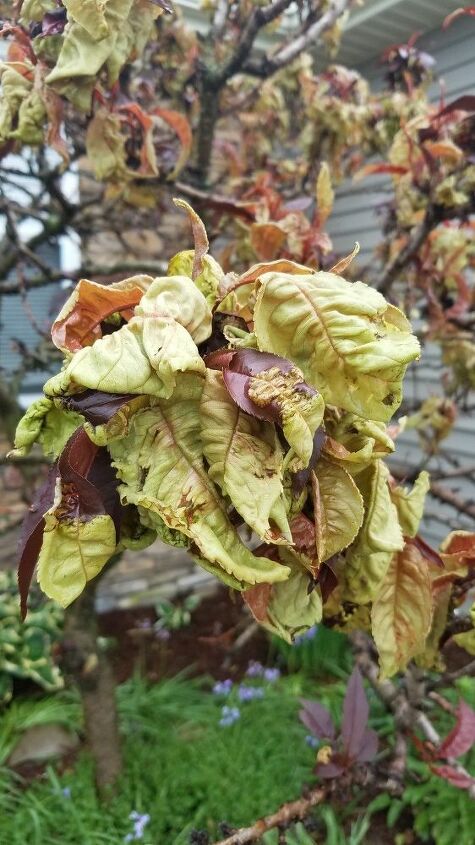
My tree is 2 yrs. old and self-planted. I have been watering it off and on this summer and I just realized it looks like it has a fungus or something. The leaves are turning yellow with brown spots and then they are curling up and turnng completely brown. The whole tree is affected ecept for leaves near the end of each branch. Can it be saved?
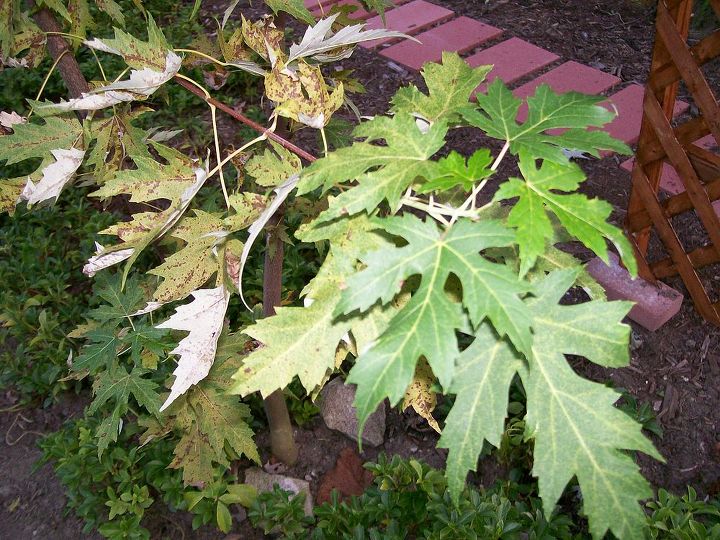
Green leaves at end, diseased leaves near trunk.
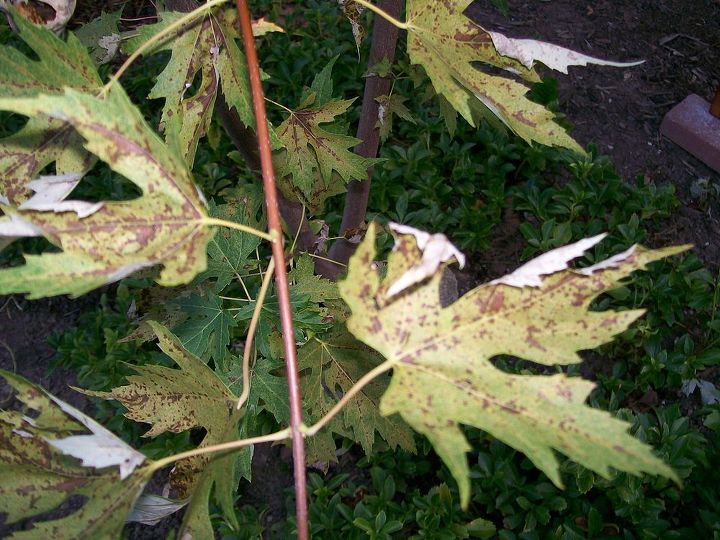
close-up of diseased leaves
15 answers
-
Do I need to worry about other trees or surrounding plants?
Dee W
on Aug 22, 2012
-
If I were you, I would email your photos and this question to Cooperative Extension. Here's the link: http://extension.osu.edu/ask-an-expert They may know of something going around, and what you can do about it. Moreover, you can help them identify problems that may be coming up in your area.
 3po3
on Aug 22, 2012
3po3
on Aug 22, 2012
-
You're lucky to have a tree self-plant in a place you actually want it, Dee. I think that looks like some sort of seasonal, environmentally induced condition that will probably not be an issue next year, but for your peace of mind you could certainly send the photos to your extension service as Steve suggests.
Douglas Hunt
on Aug 23, 2012
-
It looks like silver maple to me. If so, this is one of the reasons not to keep it. It has weak limbs, no fall color and it gets every leaf spot known to man.
 Walter Reeves
on Aug 23, 2012
Walter Reeves
on Aug 23, 2012
-
Thanks guys..really appreciate your quick responses. @Steve: I will check with the Coop today, I need to run into town for some errands anyway. @Douglas:yeah, I was so excited when it started to grow, it is in the perfect place! @Walter:I'll verify its identity at the Coop and and ask their recommendations. I would really like to keep it I can.
Dee W
on Aug 23, 2012
-
Quick update: Extension office got back to me and yes, it is a silver maple and yes, this is a seasonal thing and will not hurt the tree or other plants. Although I was told it may lose limbs in high wind or hard rain as it grows, we have decided to keep the tree for as long as it is happy. There are too many pluses to just tear it out. Thanks again for your help and advice.
Dee W
on Aug 30, 2012
-
Good luck with your tree, Dee.
Douglas Hunt
on Aug 31, 2012
-
Thank-you Douglas, enjoy the 3-day weekend!
Dee W
on Aug 31, 2012
-
To help prevent leaf spots, make sure there is adequate sun light & air circulation. Fungus develops when moisture is available on a regular basis.
TJB-INC Landscape Contractor
on Sep 05, 2012
-
Thank-you TJB-the tree is in full sun and sits in a bed of pachysandra. No other plants nearby.
Dee W
on Sep 05, 2012
-
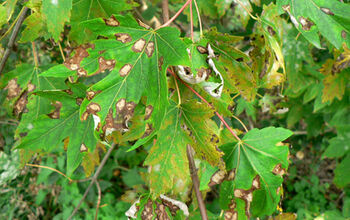
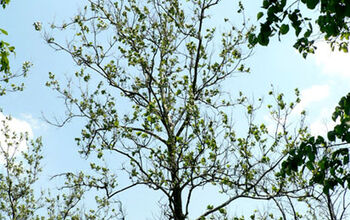
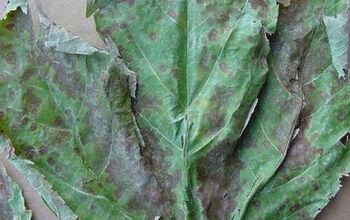
Anthracnose fungi need wet conditions to infect and spread. Foliar symptoms include small round to irregular tan to dark brown or black spots. Symptoms vary with the host plant. The images show anthracnose on sycamore and silver maple. Spots can enlarge/merge to form blotches. Veinal necrosis (along veins) may occur on sycamores, oaks, and maples. Young leaves may die and fall soon after infection. Severe defoliation usually triggers new leaf growth. Management includes growing resistant plants when possible, sanitation and the use of fungicides (preventives only).--Jim Schuster
TJB-INC Landscape Contractor
on Sep 06, 2012
-
that is more information than I got from th Co-op, thank-you. I was advised to be sure and get all the dry, fallen leaves picked up and thrown away, not composted. So I guess I need to buy a fungicide and apply every year in the spring? I was also told to prune the tree every other year, for which I have not called my tree company to see when is the best time.
Dee W
on Sep 06, 2012
-
I found this info for you. Note: All of the chemical controls should be done by a licensed arborist in your area. If you are reading this and are located in New Haven County, CT, TJB-INC has a state licensed Arborist (S-1710) on staff. My name is Ted Greiner and I am the arborist & owner. Anthracnose diseases usually do not seriously affect the health of shade trees. A severe case of anthracnose may cause defoliation in the spring, but the tree usually recovers and produces a second crop of leaves later in the season. Severe defoliation year after year, however, may weaken the tree and increase its susceptibility to insects, other diseases, and stressful environmental conditions. In addition, branch structure may be affected by the disease. On sycamore and oaks, repeated twig dieback promotes the development of side shoots, resulting in bushy growth and angular branching. On trees used mainly for ornamental purposes, even a moderate level of anthracnose may cause unacceptable aesthetic damage. Control In most cases, control of anthracnose is unnecessary because the disease is usually not damaging to the long-term health of trees. When control is desired, various techniques can help reduce the severity of the disease. Raking and destroying fallen leaves and twigs and pruning out dead branches on the tree will help reduce the overwintering population of anthracnose fungi. Pruning will also increase air circulation in the canopy, reducing the time that wet conditions, which favor fungal infection, are present on leaf surfaces. Healthy trees are more likely to recover from a severe anthracnose attack than are stressed trees. Mulching and watering during dry periods will help keep trees healthy. When selecting trees to plant, species or cultivars that are less susceptible to anthracnose should be chosen. London planetree is much less susceptible to anthracnose than American sycamore. Northern red and pin oaks are usually less severely affected than white oak species, and green ash is relatively resistant compared to white ash. At planting time, trees should be spaced far enough apart to allow good air circulation when the trees are fully grown. Chemical sprays to control anthracnose are rarely justified except when the disease occurs in stressed or recently transplanted trees, or when the disease causes repeated defoliations. Fungicides labeled for control of certain anthracnose diseases include chlorothalonil (Daconil 2787), thiophanate-methyl (Clearys 3336, Fungo 85), mancozeb (Dithane), lime-sulfur, Bordeaux mixture, and other copper fungicides (such as Tenn-Cop 5E). The first spray should be applied in the spring when buds begin to swell, followed by two to three additional sprays at 10- to 14-day intervals. For walnut anthracnose, the first application should be made when the leaves begin to unfold, followed by additional weekly sprays as needed, especially if rainy weather persists. Read label directions for more information on timing and application. Another fungicide, thiabendazole (Arbotect), is labeled for systemic injection into tree trunks for the control of sycamore anthracnose. Injections should be made by a professional arborist in the late summer or fall before leaf drop for control of anthracnose infections the following spring. Although thiabendazole injections give good control, this treatment is not recommended for use on an every-year basis because of the trunk wounding caused by the application technique. The symptoms caused by K. apocrypta appear following infection during cool, wet weather throughout the spring and summer. Infected young leaves and shoots may shrivel and turn black. On more mature leaves, red, brown, tan, or black lesions develop that may or may not be associated with leaf veins. Leaves may become crinkled or otherwise deformed. Lesions often coalesce and kill large areas of leaf tissue. In severe cases defoliation may occur.
TJB-INC Landscape Contractor
on Sep 07, 2012
-
Walter is correct in his response. Since the tree is small enough to be easily removed, do that and replant with another type of tree. Remember that Anthracnose is caused by environmental conditions, by not changing these conditions, you may have a re-occurrence with another no resistant plant.
TJB-INC Landscape Contractor
on Sep 07, 2012
-
Wow! Thank-you so much for taking the time to send all this info my way. I am taking all your expertise to heart, but also have someone coming out next week from the tree co. we use. I will make a decision based on his input as well.
Dee W
on Sep 07, 2012
Sign Up to Answer