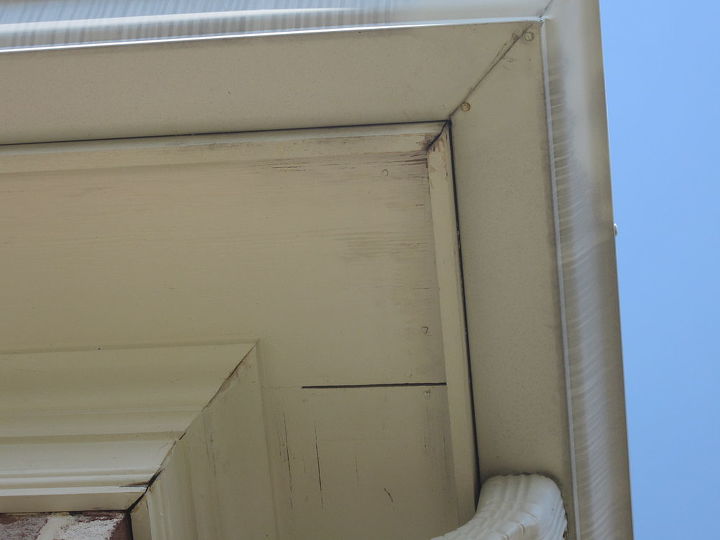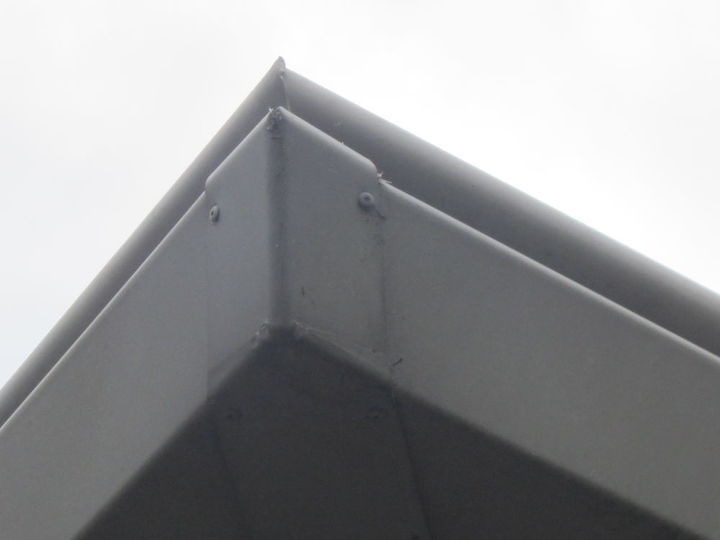


I'm convinced there is a flawed technique that is repeated with every installation.
I've seen enough to know these corners are prone to failure and cannot be remedied. I would like to see something like a contiguous, one-piece corner, say a foot long on either end. Does anyone know of anything like that on the market. I would like to recommend something that is not going to cause the same problem when a customer needs new gutters. Thanks, Charles
But that is not a fix all solution. One of the problems is that the AL metal is subject to a lot of thermal movement and that stresses joints. I have tried a number of methods and all rely on ...»
One of the bigger problems IO see with gutters is HOs who fail to clean them. I had a cal to inspect a house to find out why they had a lot of mildew growing in a closet and water leaking into the basement. As I walked up to the house, the lady came to the door to meet me. She invited me in saying, "Let me show you where the problem is"
I paused and said "I believe your closet is right over there behind this wall and the water is leaking into the basement right about over there, Right?"
Since I was still outside five feet from the house, she was in shock, thinking I had Superman's X-Ray vision. But it was simple. The roof style had almost no overhang and the gutter right there had so much debris, there were two foot tall trees growing n it. The siding was mossy from water overflowing it. And the downspout was knocked apart so water was dumping on the ground with enough force to make a divot hole in the ground to puddle water and lead it TO the foundation wall instead of away.
The saga continues.
I don't care for the poly caulk here because it cures too hard, so much like silicone on metal joints, it will pop loose eventually. I use Geocel which has about 800% elongation (stretchability) and sticks very well to clean surfaces. When I can overlap the joint by 2-3 inches, a doubled bead ...»
But there is just no perfect answer to this.
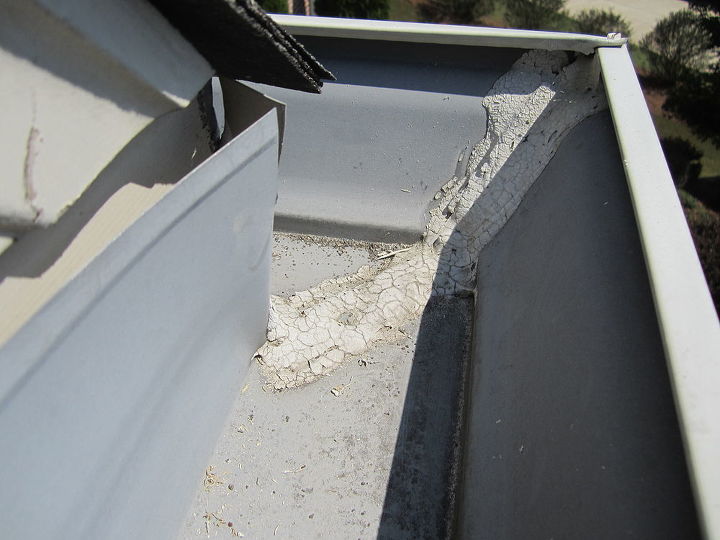
IMO,the original photo here shows a butyl caulk which was the standard twenty years ago. Butyl is a PITA to use because it is stiff and it sticks to everything. But it remains flexible for several years before hardening to get brittle.
Nichter, what you say about the K-1 sounds reasonable, I've just had my hands in enough thinner to last a lifetime, perhaps I could use a nitrile glove. I like the Geocel tripolymer too.
Best, Charles
Proper sealant use as well as the correct sealant is a must. Caulks regardless of what its used for must be applied correctly. Using more is not better.
Caulk must be able to stick to the material its supposed seal.
Caulk must be able to stretch and contract without loosing its adhesion to this material. ...»
Think of it this way. Take a fat rubber band, that is your sealant. If its about four inches long you can easily grab it, (adhesion) and stretch it in and out.
Now take that same rubber band and cut it so its only a 1/2" long. and try to stretch it. Its harder to grab correct? You have lost the the adhesion and cannot stretch it either as far or as much as before.
So if you glob on the sealant as seen on the photo, you in effect have removed the ability of the sealant to stretch because of the ratio of the thickness to the adhesion area. As the gutter in this case expands and contracts the sealant because of the way it was put on cannot stretch and it tears instead. The result is fine cracks in the surface that grow into leaks.
Using the correct amount of sealant along with the correct type and the correct construction practice that can flex properly with the movement, without all the extra exposed sealant will always work longer and better then putting as much as seen on the photo.
And as I said before it all boils down to craftsmanship.
CP
Not for AL gutters.
We have a lot of 110 Year old wood gutters up this way and other things to restore with the wood Epoxys. I use the Minwax most, but also the System Three and West systems. Lot of boat yards around here on the coast, so those two latter are easier to get than Abatron.
If not then we will try silicon caulk, it might work and would be water proof too. What do you think?
Do not use the stuff, it will make the inside of the gutter sticky and hold debris, also will not last at all.
Simply clean the seams, purchase gutter sealant. It comes in a tube much like toothpaste does. ...»
Ideally the seam should have been sealed before they applied the overlap joint, but the best you can now do is to just seal the edges.
Like there is no get rich program, there is no magical cure either. Any sealant you use will work for a short time, but using the stuff designed to fix a leak will last the longest.
As far as the design failure. The gutter joints that connect corners that rely on the gutter being mitered is junk, the only tried and true outside or inside corner is one that is factory done that the square cut end of the gutter is pushed into it and properly sealed. The ones that utilize the wrap over the miter sold in most big box stores allows for to much movement and will break just about any sealant job that you can throw at it.
CP
I've used NP1 on roof flashings with good results but not on gutters yet. We used to use ParBond but my supplier went out of business and that seemed to hold up well. We use an elastromeric sealant on our roof repairs that I will have to try on some gutter corners to see if it holds before I recommend it....