« View Post
Photos

Oops! Leave without saving?

If you leave this page, the information you have entered will not be saved!
Are you sure you want to leave this page?

Leave this page Stay on this page

Hometalk.com

  • Sign Up
  • or
  • Log In
  • Professionals
  • Community
    • All Members
    • Professionals
    • Bloggers
  • About
    • About Hometalk
    • Blog
    • FAQ
    • Guidelines
    • Resources
    • Support
    • Press
    • Contact
    • Terms of Use
    • Privacy Policy
  • Following
  • All Topics
    • Cleaning & Organization
    • Crafts
    • Design & Décor
    • DIY Projects
    • Gardening
    • Home Maintenance & Repairs
    • Outdoor Living
    • Painting
    • Remodeling
    • Repurposing & Upcycling
    See More Topics »
  • Questions
    • All Questions
    • Open Questions
    • Unanswered Questions
  • Clips
Post & Ask
Join Now Log In

Hometalk is where people share and help with everything home & garden

Steve E

Atlanta, GA
5Likes 3 Shares
  • Overview
  • Posts6
  • Send a Message

Featured Photos

About Me:

I am an architectural wayfinding consultant (go check sevcdinc.com if you are curious), living in and working out of my loft space near downtown Atlanta. I bought a small former light industrial building 12 years ago, gutted it, added a level, and basically acted as my own GC on the rehab of the building. I am also a part-time musician and writer, and enjoy all kinds of creative productivity. I love the opportunities for self-expression available to me by having the converted loft building, and the proximity to everything inside the perimeter, plus the energy inherent in living down town.

Favorite area of home improvement:

planning, design and self-expression, gardening/landscaping, decorative improvements, effective use of storage/living space, carpentry/framing/drywall, painting/faux finishes


Recent Activity


  • End view
  • Face view rifght
  • Face view left
  • Back view left- it's a little hard to see, but the concrete chunks are laid against the other side of the fence.
  • Back view right- see above
  • See 2 more photos

Raised planter

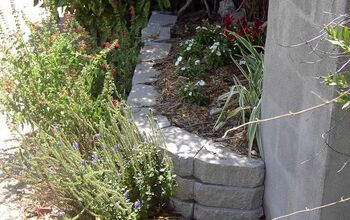
Added a raised planter to an existing planted area.

*Options I considered for this project: ...»

Stacked stone- too expensive and unstable without grouting or cementing the stones.

*Questions and unexpected events that arose during the project:

The back of the planter faced a security fence, and there wasn't room to use the paver stones at the back, or they would have taken up most of the area in the planter for actual plants. I ended up using flat chunks of the concrete that was broken up when I first created this planting area from a paved concrete parking area. The chunks were basically stacked on edge against the security fence (see photos) and held in place by the infill. They fit closely enough together to hold the infill in place.

* Cost Comments:

If you don't compost, you will probably need to budget for that. It wouldn't be much, but I always feel foolish paying for dirt.

*My motivation to do this project:

This was done purely for the aesthetic look of the raised planter, which helps define the edge of my property.

*Project Steps:

1) Trimmed away as much honeysuckle as I could without killing it. The honeysuckle has grown up around the security fence and make a nice green screen between me and my neighbor.

2) Leveled and compacted the ground where I planned to stack the pavers.

3) Stacked the pavers and put in place the first row of concrete chunks.

4) began filling the planter with composted dirt, up to the first row of concrete chunks

5) Installed a couple more rows of concrete pieces, infilling with composted dirt as I progressed.

Materials:

27 garden stack stones - $50.00

Steve E
Steve E Atlanta, GA on Sep 15, 2010
Post Comment | 94 Views
  • Share 0
  • Like 0
  • Clip 0
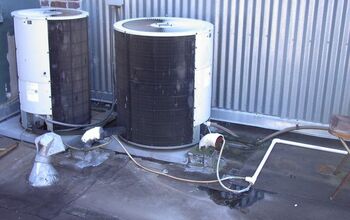
  • 2 compressors on the roof.
  • Existing drains (clear neoprene tubes) running into a single PVC drain tube
  • PVC tubing runs across the roof adjacent to existing decking
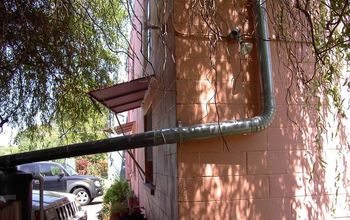
  • PVC tubing routed over the parapet
  • PVC running down wall (PVC will be painted to match wall)
  • T-outlet at end to divert drain water in 2 directions
  • See 3 more photos

Garden Irrigation from HVAC drainage

Divert HVAC condesate drainage to garden

*Options I considered for this project: ...»

The only option was to continue to pay out the wazoo to water my garden (or, possibly, to plant plastic flowers and shrubs).

*Questions and unexpected events that arose during the project:

I have two compressors on my roof, one for my space and one for a rental unit. The rental unit system drained directly onto the roof, but my system drained into a utility sink in the furnace room, so it had to be diverted to the roof. Luckily, when the system was originally installed, it had an optional pumped drain up to the roof, for use when the temperature outside is above freezing, so I was able to hook the pump up to tha tubing and send it up to where the other unit drained on the roof. You can see from the photos wher the two drains (clear neoprene tubing) on the roof are connected to a single white PVC drain tube.

* Cost Comments:

I already had PVC solvent and duct tape (what respectable handyman would be caught without duct tape?)

*My motivation to do this project:

Again (see my cistern project), I got tired of high water bills and decided to do something to cut my city water usage.

*Project Steps:

1) Diverted the condensate drain from my utility sink up to the roof. If you don't have tha convenience of a drain tube already there (see above), you will need to be sure there is a drainage pump, and attach a drain line (the clear neoprene tubing) to the pump. Making sure the tubing doesn't get crimped, you can run it through a crawl space or attic to a perimeter exterior wall, and through the wall to your garden space. Make sure the penetration point is properly sealed against weather and creepy-crawlies.

2) Once I got both systems draining out on the flat roof next to each other, I hooked them up to a white PVCdrain pipe ad ran it over to the edge of the roof and down into a planted area.

3) I made a splitter (kinda like a Y, but shaped more like a T or L) to hook a couple of lengths of neoprene tubing to, so the drained water could be diverted to two different areas in the planter.

Advice:

Do plan to protect the exposed clear neoprene tubing from the sun (not shown in my photos), or it will get brittle and decompose pretty quickly. I plan to just slip pieces of old garden hose over the exposed sections.

Materials:

(6) 10' x 3/4" PVC tubes - $6.00

PVC fittings - $5.00

Neoprene tubing - $10.00

Steve E
Steve E Atlanta, GA on Sep 15, 2010
2 Comments | Post Comment | 90 Views
  • Hudson Designs
    Hudson Designs on Oct 16, 2010
    This was a great idea. I did the same type of job for a lady in Helen when the water ...»
    restriction started. We also added a tank below her gutters and piped it to plants as well.

  • Share 0
  • Like 0
  • Clip 0
  • Existing drain after diverting
  • Roof drain diverted to top of cistern
  • Closer view of cistern- note overflow drain near top that runs down and beneath the cistern
  • Other side of cistern, shows where the overflow drain comes out below
  • Pvc drains and shut- off with brass Y-diverter and additional shut off valves
  • "Before" drain can be seen behind these guys- it used to drain directly into the parking and ran out into street, after first flooding the immediate area.
  • See 3 more photos

Installed a rain water cistern

Installed a 160-gallon recycled chemical storage barrel to hold rain water diverted from the roof, for use as garden irrigation. ...»

*Options I considered for this project:

Store-bought drums or barrels may be a little more attractive, but I couldn't find any this big.

*Questions and unexpected events that arose during the project:

I had to make sure the barrel was elevated enough to gravity-feed all parts of my garden area. Also, mosquitos are a problem around my property, so I needed to make sure they couldn't breed in the cistern.

*My motivation to do this project:

Water bills in the City of Atlanta are extremly high. Saving my rainwater for garden irrigation has cut my water bills in half.

*Project Steps:

1) Used cinder blocks and slate shims to provide a solid level stand for the barrel.

2) Diverted the existing roof drain to the barrel.

3) Installed mosquito netting (fiberglass window screen material) over the drain opening in the top.

4) Installed PVC hose connectors in the existing drain connection at the bottom of the barrel, and a PVC overflow drain (also attached to an existing connection near the top of the barrel).

5) Installed a Y-converter, so I could attach multiple hoses or leave a hose attached and still fill a watering can easily.

6) Attached hose and commenced watering.

Advice:

Do realize that this shouldn't be used for drinking water. Mine drains from a flat rubber roof that has roofing compond repairs made to it, so it surely has some chemical-type stuff in it by the time it gets into the barrel. I have used it to refill a small fish pond, and the fish don't seem to mind, but I wouldn't drink after them, either.

Materials:

Barrel - $100.00

PVC tubing and fittings - $10.00

brass fitting - $9.00

Soaker hose - $9.00

Fiberglass screen - $2.00

Steve E
Steve E Atlanta, GA on Sep 15, 2010
3 Comments | Post Comment | 621 Views
  • Steve G
    Steve G on Oct 17, 2010
    This is a great idea. You're lucky you can do this. I live in Colorado, and the bizzaro world ...»
    of Western US water law bans rainwater capture and storage. You don't actually own the water that drips off your roof, so you can't collect it.

  • Share 3
  • Like 5
  • Clip 7
Clipped to:
  • Amazing Projects
  • Gardening tips
  • Yards..Garde...
  • View from below
  • Transformer assembly and anchors in drywall
  • Upper anchors (not level- see notes) in wood laminate beam
  • View at top of stairs
  • Old fixture can be seen behind my head
  • See 3 more photos

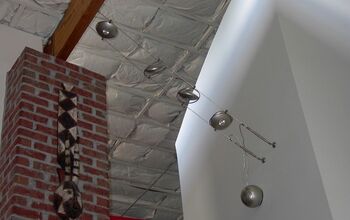
replaced existing wall-mounted fixture with suspended low-wattage spot fights

Removed existing industrial-looking light fixture and replaced with low-wattage decorative suspended spot lights. ...»

*Options I considered for this project:

I considered another wall-mounted fixture, but I liked the look of the suspended fixtures.

*Questions and unexpected events that arose during the project:

Installing the project was tricky, because it is over stairs. I had to use cinderblocks to create a level surface for a ladder. don;t recommend this without someone to hold the ladder steady. The installation instructions provided with the IKA lighting kit are a bit cryptic, since they try to cover all possible conditions, and they do it with no written instructions (just pictures), but if you have any experience at all with home improvement projects, you should be okay.

* Cost Comments:

Pretty much everything needed was included in the IKEA kits (except tools, of course). I did some repainting after installation, but didn't count this as part of the project.

*My motivation to do this project:

The existing fixture was unattractive, and the lighting was harsh and unfocused. There is artwork that I wanted to light and I wanted to be able to direct the light on the stairs beneath the fixture.

*Project Steps:

1) Removed the old fixture, exposing the existing junction box in the wall.

2) Repaired drywall nicks and holes around the junction box

3) Installed transformer assembly over junction box.

4) Installed cable anchors in framed wall and wood beam. his was tricky because the two surfaces were not parallel to each other, so the anchors had to be carefully positioned to keep the cables parallel to each other. The anchors were level with each other on one wall, but couldn't be that way oin the other one, or the cables wouldn't end up parallel.

5) Installed the cables.

6) Installed the spot lights on the cables

Advice:

Do expect to purchase the spot lights separately, and check how many (minimum and/or maximum) can be installed. IKEA does sell some complete sets of fixtures, but the one I used was not one of them.

Materials:

Light kit - $80.00

4 Spot Lights - $60.00

Steve E
Steve E Atlanta, GA on Sep 15, 2010
Post Comment | 76 Views
  • Share 0
  • Like 0
  • Clip 0
  • From behin closet, in storage room, with shelf on top
  • See 2 more photos

Added closet to existing guest room

I completed a closet in a previously built-out guest room. I had already framed out the opening and had a floding door in place, but the opening led into an adjacent storage/furnace ...»
room, which also had a separate entry door from the guest room.

*Options I considered for this project:

I left it undone for a couple of years, so I guess the option was whether or not to finish it.

*Questions and unexpected events that arose during the project:

Fastening the framing to the existing drywall (the faux-finished wall in the photos) was tricky, because that wall had drywall mounted on acoustic rails, in order to minimize sound transmission betwee my building and the building next door, which had adjacent (almost touching) exterior walls, and the adjacent building was used as a punk rock club when I bought and renovated my building. I used wall dogs and Liquid Nails (stuctural adhesive) to fasten the framing into the drywall.

* Cost Comments:

This added an approximately 2x3 foot closet, with a shelf on top accessible from the storage room.

*My motivation to do this project:

To add closet space for guests to hang clothes, etc., and create storage space above the closet (accessed from the storage room side).

*Project Steps:

1) Drew a framing plan and purchased material

2) Built the framing walls (two) separately, then bolted them to the existing concrete floor slab using lead anchors, secured them to gether and to the existingdrywall framing (see above)

3) Installed new drywall to framing and finished with drywall tape and joint compound.

4) used structural adhesive to fasten a melamine shelf to the top of the framing, which did not go all the way to the ceiling (see photos taken from storage room)

5) Installed wall baseboards and trim

6) Painted walls and trim.

7) Installed wire shelving

8) Installed knob on existing door.

Advice:

Do use pre-mixed joint compound- the powdered stuff is a pain.

Do wet-sand the joint compound, using a damp sponge, instead of regular sanding. I always do this in finished areas, to keep from getting dust from the joint compound everywhere.

Materials:

2x4 framing - $30.00

drywall - $13.00

Melamine shelf - $7.00

Wire shelving and hardware - $25.00

Closure knob - $5.00

Steve E
Steve E Atlanta, GA on Sep 15, 2010
1 Comment | Post Comment | 182 Views
  • KMS Woodworks
    KMS Woodworks on Oct 18, 2010
    You can never have too much storage eh?...like the pic of the back showing how both sides can ...»
    be used

  • Share 0
  • Like 0
  • Clip 0
  • Painted slab looked like this before
  • Slate to terra cotta metal transition strip and base wall trim
  • Slate to laminate floor wood transition strip (one of two)
  • See 3 more photos

Slate Floor in Living Area

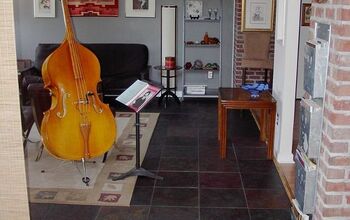
I put down approximately 600 square feet of 16x16 inch slate tile over a painted concrete slab. The project included cleaning/sanding the painted slab, setting, sealing and grouting the ...»
tile, installing new transition strips, and installing new baseboard trim around the new floor.

*Options I considered for this project:

I never considered anything other than the slate. I looked at different types of slate and sizes of tiles.

*Questions and unexpected events that arose during the project:

1) I knew that slate, as a natural material, would have some variations in thickness, but was surprised at the amount of variation. The tiles varied from about 3/16" to 3/8" thick. I found some small plastic shims in the ceramic tile section of Home Depot that I was able to use to raise up the thinner tiles, making sure there was enough thinset cement to fill any voids left from shimming.

2) I started grouting a portion of the floor, and when the grout set and dried, it was much lighter in color than the samples in the supplier's showroom, and was inconsistent in darkness. I was told that the light color and the color variations were due to my not carefully measuring the amount of water used in mixing the grout, and could also be caused by using too wet a sponge when wiping off the excess grout. I ultimately bought a dark color grout stain and hand-painted the grout joints with it. Time-consuming, but it looked 100% better for having done that.

*My motivation to do this project:

The painted concrete was unsightly and was never intended to be the finished floor.

*Project Steps:

1) Sand and clean the painted concrete slab, remoning most of the paint and old flooring residue.

2) Measure the floor area and purchase 10% more tile than the area to be tiled.

3) Lay out a grid starting in the middle of the area, using the nominal (16x16 inch) dimension. Plan for the cut tiles around the perimeter. Plan on laying all the solid tiles before cutting the edge tiles (not as critical if you have a heavy-duty tile saw- I had to rent one).

4) Starting in the middle of the area and working out, mix enough grout to set about a 10 foot square area and set the slate using tile spacers to control the width of the joints, and shims to level them.

5) After all the tile has been set, use a sealer to coat the top surface of the tile to protect it from grout staining during the grouting process.

6) Mix enough grout (carefully measuring the amount of water recommended by the manufacturer) to do about 10x10 feet, and use a grout float to force the grout into the joints and scrape up excess.

7) Before the grout has set completely (a couple of hours- see grout manufacturers' recommendations), use a damp, not soaking wet, sponge to wipe up residue. wipe up as much as possible with the sponge, and when the surface had dried, use a terrycloth towel to wipe off the remaining haze. (You should be able to give the grout a few more hours to set before using the towel to wipe up the haze.) Any residual cloudiness will go away when you seal the slate.

8) Following manufacturers' instructions, apply clear sealer to the slate and grout.

9) Install transition strips and base trim.

Advice:

1) Don't choose a grout color that is radically different from the slate. If it stands out, it will accentuate any variations in the width of the grout joints.

2) Do plan on shimming the tiles to avoid big differences inthe level of the finished floor.

3) Don't do this if you have back problems. My back has yet to forgive me.

4) do buy at least 10% more tile than the size of your finished space, to allow for breakage, waste, etc.

Materials:

660 sq ft slate tiles - $1287.00

Thinset cement, grout, tile sealer - $470.00

New base molding and quater-round - $35.00

New transition strips - $47.00

Sander rental - $37.00

Wet saw rental - $42.00

Grout stain - $59.00

Steve E
Steve E Atlanta, GA on Sep 15, 2010
Post Comment | 285 Views
  • Share 0
  • Like 0
  • Clip 0
Back
to top
Feedback