

« View Post
Photos

Oops! Leave without saving?

If you leave this page, the information you have entered will not be saved!
Are you sure you want to leave this page?

Leave this page Stay on this page

Hometalk.com

  • Sign Up
  • or
  • Log In
  • Professionals
  • Community
    • All Members
    • Professionals
    • Bloggers
  • About
    • About Hometalk
    • Blog
    • FAQ
    • Guidelines
    • Resources
    • Support
    • Press
    • Contact
    • Terms of Use
    • Privacy Policy
  • Following
  • All Topics
    • Cleaning & Organization
    • Crafts
    • Design & Décor
    • DIY Projects
    • Gardening
    • Home Maintenance & Repairs
    • Outdoor Living
    • Painting
    • Remodeling
    • Repurposing & Upcycling
    See More Topics »
  • Questions
    • All Questions
    • Open Questions
    • Unanswered Questions
  • Clips
Post & Ask
Join Now Log In

Hometalk is where people share and help with everything home & garden

1
Find me on g+
Sharon Bothwell
Sharon Bothwell Blogger Redding, CT on Dec 31, 2012
Like Clip

Remodeling? Don't Get Caught with Your Pants Down.

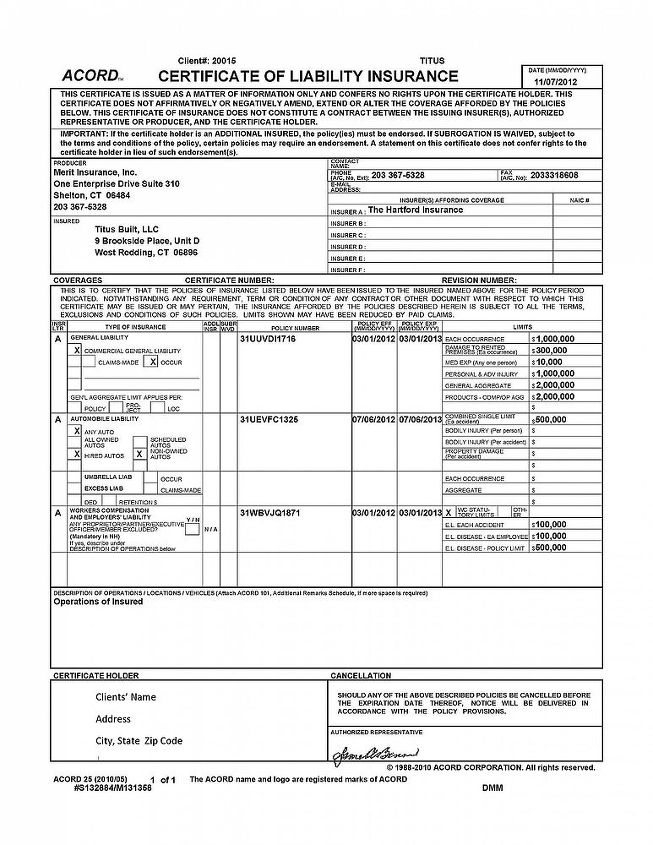
Make sure your contractor has a Certificate of Liability Insurance

Homeowners, beware: nobody should step on your jobsite without a Certificate of Insurance which has been checked and verified! If you are doing business with a service company that will be working on your premises, you should first make certain that the company has sufficient liability insurance. If work will be performed by the company's owner himself, without other employees, a general liability policy is sufficient. However, if the owner has employees that will be working onsite, workers' compensation insurance is required.

The best way to obtain the Certificate is to have the service company's insurance broker forward the Certificate to you. The Certificate should name you, with the jobsite address, as the Certificate Holder and should name you as the "additional insured." This Certificate will give you proof that coverage is valid, as well as provide you with protection for yourself and 3rd parties in the event a 3rd party sues you due to negligence of the contractor. It will also inform you of the amount of insurance coverage provided so you may determine whether or not the coverage is sufficient for your needs. (For more information, contact your insurance broker.) ...»

Note: In addition to the Certificate of Insurance, homeowners should have a written contract with the contractor which includes "hold harmless" language protecting the homeowner. If a claim is reported and the service company has not provided you (the homeowner) with a Certificate, the claim will go directly against you. If your insurance policy does not cover service companies, the cost of the claim will come directly out of your pocket.
  • Like Clip
    Titus Built, LLC Certificate of Liability Insurance
Post Comment | Like | Clip | Share
1105 Views
12 Comments
  • Southern Trillium LLC Stone Mountain, GA
    Just as info. There is typically no cost involved in having a Certificate of Insurance issued with the recipient's name and address on it. But to be listed as an additional insured will incur fees, possibly around $100 for each issuance. So, as a homeowner requesting this, the contractor may be glad to provide it for you, but may be looking to pass that extra fee on to you.
    on Dec 31, 2012 · Like 2
  • Miriam I New York, NY
    Thank you for this!
    on Dec 31, 2012 · Like 1
  • Jeanette S Atlanta, GA
    One other thing you want to do is to make sure they have workmans comp too because this is a separate insurance from liability! And if you are paying someone, your homeowner's insurance covers nothing! Do not accept a copy from the contractor...have his insurance company send it to you!
    on Jan 01, 2013 · Like 0
  • Sharon Bothwell Redding, CT
    Jeanette S, I agree. If look at the end of my 1st paragraph it states ... workers' compensation is required. And, yes, make sure the Certificate comes from the insurance company and you, the customer, are designated as the Certificate Holder.
    on Jan 01, 2013 · Like 0
  • Kim Merrett Arlington, TX
    Texas is one of the few states that does not require a company to carry work/comp insurance. It is optional. if living in Texas and you want/expect your contractor to have work/comp, do not assume they are covered. As mentioned in other comments, have the insurance company send you the certificate directly instead of accepting a copy from the contractor.
    on Jan 01, 2013 · Like 1
  • Kelly S Bremerton, WA
    Great info to start out the New Year. All I knew was to be sure they were licensed, bonded, and insured. I know that being licensed doesn't me they are competent because there is no specific test for general handyman license in our state. Be sure to ask for references and then actually contact them. This spells out more specifically what kind of insurance. Thanks all.
    on Jan 01, 2013 · Like 1
  • Southern Trillium LLC Stone Mountain, GA
    An issue that you typically hear on the news is when a homeowner gives a contractor a deposit and the contractor disappears. Or sometimes, the contractor requests additional money during the project, and at some point, the work ceases, and the homeowner has little to no way to locate or find the contractor or individual.

    Many companies will ask for some type of deposit amount, but the amount should be fairly ...»

    small. If the contractor needs a large amount of money up front, that should be a warning flag. It might mean that the contractor/company has little to no available credit at vendors to purchase materials. If the contractor is good and pays their bills, they should have no problem purchasing their materials either in full with operating money, or on credit from the vendors. And you would like to think that a contractor or company should be able to make their payroll without needing your large deposit up front. Again, these may be signs that the person you are dealing with is not financially sound and may be warning flags. This isn't always the case, but it is something to watch out for.

    On the other side, a small company or contractor always carries some worry that the homeowner may not pay up. So, imagine the contractor purchases $5,000 in materials and does work for one week and the homeowner decides to not pay, the contractor is the one that loses. Yes, there is a legal process to lien the house and try and collect, but the time and costs involved can exceed the amount owed, so sometimes it is truly lost. It only takes a single bad experience to leave the bad experience in a contractor's mind.

    The best way to go about it would be to have a reasonable deposit amount, with the amount and terms listed in a signed contract. On a larger project, the contract should spell out when draws, or intermediate payments, may be collected. This way, both parties are more protected during the process. In our one bad case, we left way too much remaining to the end of the job, and that client happened to be the one to

    on Jan 01, 2013 · Like 1
  • Sharon Bothwell Redding, CT
    Southern Trillium LLC, The contract should cover several points of interest for both the contractor and the client. Titus Built always "spells out" the following information in their contracts: Start / Completion Dates, Changes to the Scope of Work, Price and Payment Terms (Schedule), Builder's Insurance, Owner's Insurance, Allowances... the list goes on. The more that is spelled out in the contract, the less can be unconstrued.
    on Jan 02, 2013 · Like 0
  • Leslie D Las Vegas, NV
    Just being named as "additional insured" on the front of the certificate does not necessarily cover you. The main thing to ask for is to be named as "additional insured by endorsement to the policy". You will then get a certificate, with you named as additional insured on the cert, but it will also include a 2nd page, stating that the policy has been endorsed/changed. Always call the insurance company to verify that the certificate is valid. As a Contractor, I have seen faked certs a few ...»
    times. As mentioned above, some insurers charge their insured a $100 fee for doing this, so be prepared to have this cost potentially tacked on to your contract with them. Also, your mortgage company may have language within your contract with them to assure that they are also named as "additional insured"...this way, if the contractor burns your house down, their interests are covered, as well.

    on Jan 02, 2013 · Like 1
  • Sharon Bothwell Redding, CT
    Thanks for your great input, Leslie D!
    on Jan 02, 2013 · Like 1
  • Kevin M. Veler, Law Offic... Alpharetta, GA
    Great information Sharon. One more point. Be sure that the name of the insured contractor is also the contractor's entity name on your contract. If you contract with Joe X Construction LLC, that should be the name on the insurance certificate. Not Joe X or Joe X Construction Company.
    on Jan 19, 2013 · Like 1
  • Sharon Bothwell Redding, CT
    We run into this problem quite often with the subs. The Certificate states one name and their invoice states another name. I always tell the subs to send me the Certificate in the name on the invoice or else I will have to cut the check under the name on the Certificate.
    on Jan 21, 2013 · Like 0

NOTE: You can drag and drop your photos to reorder them
Required
Comment Saving...

Related Posts

  • 100 Year Old Kitchen Reno-red stove pops in a white kitchen with carrara marble. Demijohn lights add drama #Bestof2012
  • Boring Kitchen Gets An Upscale Renovation With Family In Mind
  • Our Kitchen Makeover
  • 7 Likes

    L.E. & Company SLS Construction Solutions Cheryl Hicks-Nichols Kelly S Kim Merrett Jennifer Schmitz Amanda M

Clipped to 10 Boards »

  • Ben
    Things Every Handyman Should Know
    by Ben
  • Miriam I
    Bathroom Remodels
    by Miriam I
  • Khalimah Glover
    Plants & Flowers
    by Khalimah Glover

Related Topics

Remodeling

Recent Questions »

  • Kathy.cronin1@verizon.net
    Lighting in kitchen
    33 minutes ago 2 answers
  • Ripley
    Building a "Sleep Pod."
    8 hours ago 2 answers
  • Have a question?
    Ask now & get answers»
Back
to top
Feedback