

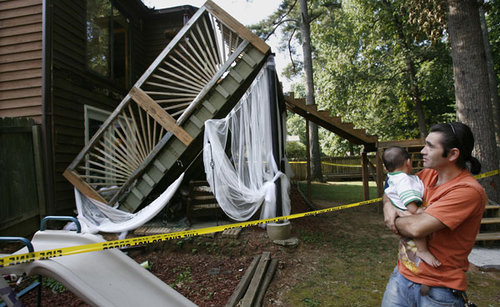
This weekend, a Marietta, GA deck collapsed sending 2 people to the hospital. Since 2003, there have been thousands of reported injuries and more than 20 deaths as the result of deck collapses. The American Society of Home Inspectors recommends checking your deck at least once a year for these warning signs of impending issues:
-Loose connections (for example, a wobbly railing)
-Missing connections (for example, the deck is just nailed to the side of the house)
-Corrosion (such as red rust)
-Rot and large cracks
Read more about deck safety on our blog: http://bit.ly/K7Dtgi
@AK and Woodbridge we found a whole lot of problems when we demolished our tiny front porch 5 years ago. No flashing was one of the big problems, but so was the missing bolted ledger board. The structure was only 10 yrs old but we ripped it down by hand in 20 minutes with just a regular claw hammer and 3 smacks with a 5lb splitting maul. The new porch was installed correctly by a very reputable contractor in less than a week.
Initially he didn't want me to add structure to his deck but the very next day there was a deck collapse and an older gentleman was burned very badly by the grill they had on their deck. So he changed his mind and helped me put the extra structure on his deck.

Again, any deck should be self supporting and not depend on the house to carry it. Why then are they still built that way? Because it is a couple of hundred dollars cheaper than building them the safe way. Many builders are so concerned about a few hundred bucks that safety takes a back seat to the money. I find that to be wrong and disturbing. But I have seen this going on for 35 years now and not one person in the building trades that I have ever spoken with is interested in addressing this issue with anything more than window dressing and no substance.
Even this in the OP they are talking about checking connections instead of dealing with the issue of inadequate structure. And depending on the house to carry the deck is inadequate, period. The deck should support itself and attach to the house if you want to not because you have to. A good deck design will still be standing when the house falls down not the other way around. Not the mention the negative impact of the deck weight on the house over time. I can not say it enough, the deck should not be carried by the house, rather it should stand on its own.
But given the real world and the lack of professionalism with many of the trades and with the township approving these structures as they are built. Regardless of the method to attach or to free stand, it must be constructed correctly using the proper tools, fasteners, f lashings and lumber dimensions.
Structure is the most integral part of the deck in either case.
Thanks for sharing.
That being said most decks are supported by the house and are an accident waiting to happen. That can easily be remedied by adding posts to the house side so that any downward force is carried by the posts and not the house. That won't solve every issue with a deck supported by the home but it will remove downward force on the attaching hardware which is the focal point for failure. For me that brings peace of mind and removes the worry of what is going on behind that board where you can't see the bolts or their condition. That is all we did to my brothers deck to remedy its issues, that and add gussets to the existing posts to remove the shaking issue he had. I see that some folks here are having the same problem as he was. It is not hard to fix the issue, it just takes a little time and effort.
In GA, in most circumstances, a contractor working an a deck above grade is REQUIRED to have a state contractors license (minimum Residential Basic) and permits are required to be pulled. Cutting corners could costs the lives of a family member. Ask my homeowner who cannot go out onto his new deck....and we'll probably never collect a dime from the unlicensed contractor unfortunately even after I get a judgment.
Under the new deck he built a U brace with extra beams to provide adequate support for the structure. It could also be done with poles under the corners of the bay.
Our new deck is beautiful and safe!
Linda it seems as if you had an unusual and very good contractor who knew what he was doing and had his focus in the right place, safety first!!
However, the problem shown in your photos is that the joists appear to have been end nailed which will not hold. There is no sign of any toe nails to hold them and resist pullout so pull out is ...»
A ledger is a good system when done right and is still an approved method in many, if not most, jurisdictions, but just like hangers, it must be done right for it to suceed.. On the other side of this, look at how many Simpson hangerss get installed with the wrong nails or with sheet rock screws.
Many times I find people that attach their decks to the brick surface of their homes with ...»
I am hearing so much about the house connection but very little about the posts which are just as important for stability.
Most decks are built as a post and beam structure. These structures are designed to receive stability from the ground that they are buried into. In most cases pole barn builders dig 48" deep. Here in Northern Indiana we have a frost line of 36" that we need to stay below. A concrete footer should be placed in the hole "underneth" the post, and a collar around the post to prevent uplift. You are just asking for trouble if you mount the posts onto your 3" thick patio slab. A stable deck has less chance of pulling away from the house.
The ICC (International Code Councel) has reviewed deck failures across the country and still allow deck attachments to the house. There has been some recent changes to the IRC (Residential Code) here in Indiana that deal with those failures,but in most cases failure is caused by an improper instalation. ...»
When a properly "attached" deck is built to current code specifications it too is less likley to fall.
http://www.networx.com/article/7-reasons-you...
In this recent deck build it was completely free standing....as this is the best. ...»
http://www.hometalk.com/Kevin/project/2602