

Planting Aloe Vera in Pots: Plus the Soil Mix to Use
I want to share what I’ve learned about planting Aloe vera in pots along with the potting mix I use and other things good to know.

Aloe vera is a plant I love and have always grown in pots, both in the house and in the garden. It’s a plant that does great in containers in a grow pot or directly planted in.
An important thing to know about planting Aloe Vera (Aloe barbadensis, Medicinal Aloe) has to do with its makeup. This plant is a succulent which means it stores water in its large fleshy leaves (we want all the gel we can get!) and thick, fibrous roots.
It can rot out very easily and quickly when overwatered and/or when the soil mix is too heavy and doesn’t readily drain.

Step One: Soil Mix For Planting Aloe Vera In Pots
The soil mix needs to provide good drainage and aeration. A lighter mix won’t hold too much water and allows the excess to drain out. This greatly lessens the chance of the soil staying too wet which eventually leads to root rot.
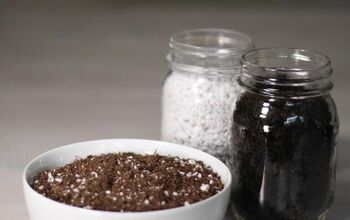
I make my own succulent and cactus potting mix. It’s comprised of coco chips, coconut coir (a more eco-friendly substitute for peat moss), pumice, vermiculite, agricultural lime, and elemite.
I use this DIY mix for all my succulent and cactus container plantings both indoors and outdoors.
I recommend that you use a straight succulent and cactus mix or 1/2 succulent and cactus and 1/2 potting soil.
For an Aloe vera houseplant, you can also use regular potting soil but perlite or pumice must be added in to aerate and amend the drainage. When using a potting soil blend, back off on the watering frequency because it’s most likely a heavier mix.
Succulent and cactus mixes really vary depending on the brand. Some are heavier than others.
If you think your mix needs the drainage and lightness factors elevated, then, by all means, add pumice, perlite, or lava rock.
You don’t need to add compost or worm compost to your potting mix but it’s how I feed all my container plants, both inside and out.

Step 2: Where to Purchase Succulent Mix & Amendments
We have many nurseries and garden centers here in Tucson that sell succulent and cactus mix as well as amendments. In case you don’t have any nearby, I’m including these online options.
Mixes
Brands I’ve used include Dr. Earth, EB Stone, Bonsai Jack( this 1 is very gritty; great for those prone to overwatering!), and Tanks’. Other popular choices are Superfly Bonsai (another fast draining 1 like Bonsai Jack great for indoor succulents), Cactus Cult, and Hoffman’s (this is more cost-effective if you have larger containers but you might have to add pumice or perlite).
Most of these mixes and amendments can be bought in smaller-sized bags if you’re short on storage space or only have a few succulents. All the succulent mixes I’ve purchased have been good for indoor/outdoor use.
Amendments
To lighten a mix: Options include Pumice, Perlite, and Lava rock.
As nourishment: Worm compost and Compost.

Step 3: How to Split Aloe Vera
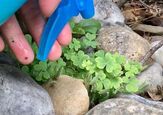
The pups grow attached to the base of the mother plant as seen in photo above. If the baby plants are small enough, you should be able to gently separate them with your hands.
I used the trowel to split the pups I was planting. You can see me doing this in the video below. I could have used a very sharp knife instead but the trowel worked just fine this time.
For a larger aloe plant with a tight, tough root ball I’ve used my pruning saw and also a trenching shovel.
You might lose a leaf or two in the process and it might not divide as evenly as you’d like but don’t worry. Aloe vera has thick roots and is one tough cookie!

Step 4: How to Plant Your Aloe Vera
Water your Aloe 5-7 days before planting. You don’t want it to be bone dry, but not soaking wet either.
Gather your materials.
Remove the plant from the pot. You may be able to do this simply by pressing on the pot or you may need to run a knife around the perimeter of the pot to get the root ball out. If it’s really stuck and as a last resort, you may need to break or cut the pot.
Gently massage the roots to loosen them. This gives them a head start on spreading in the new pot and soil mix.
Eyeball or measure (I do this with my hand or arm) how much of the mix you need to put in the pot. I raise the rootball up 1/2″-1″ above the top of the pot because the weight of the plant will eventually sink it down a bit.
Put the mix in the bottom of the pot.
Place the plant in the pot. Adjust the level of the soil if necessary.
Fill in around the rootball with mix. I add in small amounts of worm compost and compost as I plant and also as topdressing (optional).

Step 5: How To Care For Aloe Vera After Planting
I put the pot in bright indirect light outdoors so the plants were set to root in. You’ll want to put yours in a similar situation so the roots can anchor in without the stress of any hot sun.
If your repotted Aloe vera is a houseplant, put it in a spot with bright light but no direct no sun.
I watered my Aloe planting after a week or so. The temps are cooler here in the Arizona desert these days but if it was summer, I would have watered it after 4-5 days.
For a houseplant growing in average temps, I’d wait a week or so.
Then, water your Aloe vera thoroughly and let it dry out before watering again.

Happy gardening,
Nell Foster of JoyUsGarden.com























Frequently asked questions
Have a question about this project?